
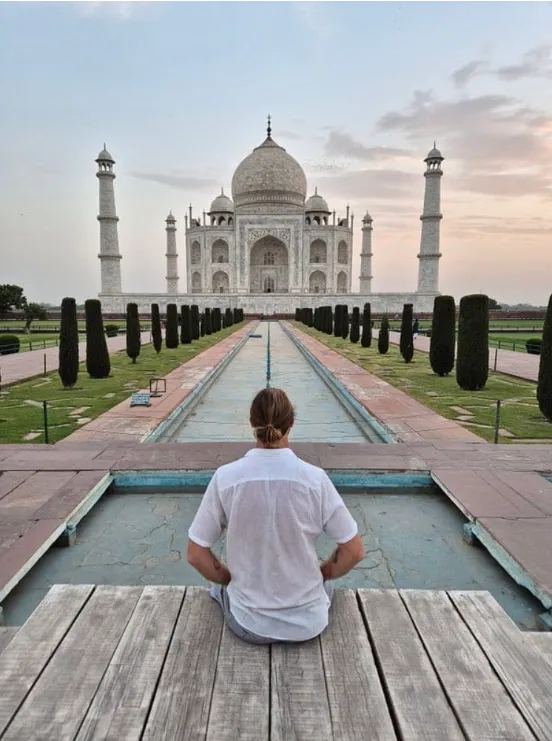
When most people think of the Taj Mahal, they picture the classic postcard shot: a massive white dome reflecting perfectly in a long garden pool. But focusing only on that single view is like listening to just the chorus of a complex symphony.
Built in Agra between 1632 and 1648, this monument was not merely constructed; it was meticulously engineered to challenge human perception. Beyond the standard historical narrative of Emperor Shah Jahan’s grief, the Taj Mahal stands as a masterclass in ancient engineering, acoustic design, and structural psychology.
Engineered to Trick the Eye
The creators of the Taj Mahal, led by chief architect Ustad Ahmad Lahori, relied heavily on sophisticated mathematics to ensure the structure felt grand yet deeply intimate. They utilized architectural anomalies that most visitors walk right past without noticing:
· The Whispering Dome: The interior acoustics of the main tomb chamber are engineered with a prolonged reverberation time. A single spoken word or sung note echoes for nearly 28 seconds. This wasn’t an accident; it was designed so that the continuous prayers chanted for the Empress Mumtaz Mahal would hang in the air, creating a sonic blanket over her resting place.
· The Perfect Grid: The layout relies on radical symmetry. Every single element—from the placement of the garden channels to the windows on the main facade—has a mirror counterpart. The only break in this flawless geometry is the cenotaph of Shah Jahan himself, which was added next to his wife’s after his death, disrupting the otherwise perfect balance of the room.
· The Minaret Safeguard: If you look closely at the four corner towers, they lean slightly outward by a fraction of a degree. This subtle tilt counteracts an optical illusion that would otherwise make them look like they are leaning inward toward the main dome. Furthermore, if a severe earthquake struck, the towers would fall outward onto the grounds rather than crushing the central tomb.
The Anatomy of the White Canvas
The stone used to face the monument is a unique type of high-quality Makrana marble from Rajasthan. It possesses a crystalline structure that makes it highly translucent. Because of this, the monument behaves like a giant mood ring for the sky:
|
Time of Day |
Visual Shift of the Marble |
Atmospheric Mood |
|
First Light |
Soft pink and lavender hues |
Quiet, ethereal, and misty |
|
Midday |
Crisp, bright, blinding white |
Sharp, imposing, and regal |
|
Dusk |
Warm amber, gold, and deep ochre |
Somber, reflective, and poetic |
To catch this metamorphic shift at its absolute peak, timing your journey perfectly from the capital is essential. Experiencing the crisp transitions of light requires arriving before the sun clears the horizon. Securing a Sunrise Taj Mahal Tour from Delhi places you inside the complex right as the morning fog lifts off the adjacent Yamuna River, revealing the pinkish-gold silhouette of the dome before the intense heat and midday crowds arrive.
The Microscopic Masterwork
Up close, the monument ceases to look like a building and begins to look like a giant jewellery box. The intricate floral patterns climbing up the walls are crafted using pietra dura (locally known as parchin kari).
Artisans used diamond-tipped tools to hollow out tiny grooves in the hard marble, then inlaid thousands of precisely sliced semi-precious stones. A single, small flower blossom on a wall can contain more than 60 individual pieces of carnelian, lapis lazuli, jasper, and jade, fitted together so smoothly that you cannot feel the seams with your fingertips.
“The Taj Mahal rises above the banks of the river like a solitary tear, frozen in time and marble, capturing the light of a changing world.”
For those looking to explore these intricate details without navigating the chaotic logistics of regional transit, opting for a curated Taj Mahal Luxury Tour From Delhi provides private transport via the high-speed expressway, fast-track entry gates, and expert historians who can point out the hidden mathematical quirks and floral secrets hidden within the stone.
The Taj Mahal remains a global wonder not simply because it is beautiful, but because its architects understood how to manipulate light, shadow, and human emotion using nothing but raw stone and imagination.
